Why I Went Back to Figma After Switching to Paper Design
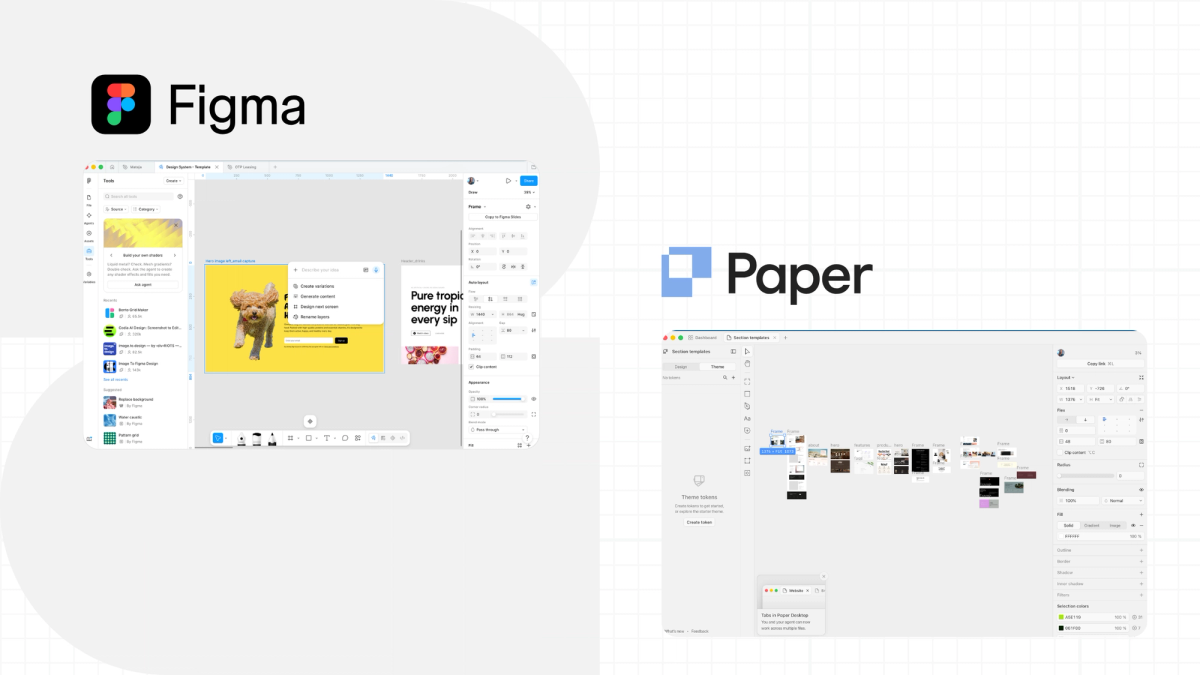
In April I wrote about Figma and Paper Design as two different bets on the future of design, and I came down on Paper's side. So I moved into Paper.
Now I am back in Figma. Not because the bet was wrong. I still think Paper's foundation is the more interesting one.
What made me open Figma again
The agent, mostly.
Figma put an AI agent directly on the canvas in May. Not a prompt box off to the side that generates a screen and hands it to you. It works inside the file you are already in, on your components, your variables, your layers. You can point it at a frame and tell it what to change.
That was enough to make me resubscribe and try it, and once I was in there the rest of it added up fast.
Figma Motion, announced at Config in June, animates components and exports video from the same file the design lives in. A Chrome extension that captures a live webpage as editable layers, in beta on paid plans. Shaders you can generate by prompting. Agent skills in August, markdown files that shape how the agent behaves, with a library of them on the Community.
And underneath all of it, everything that was already there. Vector and drawing tools with years of work behind them. Components and variants that do what I need without me thinking about it.
Then there is Payload. Figma acquired them and we build on Payload CMS for basically everything. I have no idea what that integration will look like or when it lands, and it might come to nothing. But if design files and CMS structure ever properly meet, I would rather already be in the tool where that happens. That is a bet, and I know it is a bet.
The agent, honestly
I have used it for a while now.
It is not going to design for you. You would expect a tool built by Figma of all companies to have some design instinct and it really does not. Layouts come out off. Ask for variations and you get slight reshuffles of the same idea. Give it a vague instruction and it wanders.
Which is fine. The design should be coming from the designer anyway.
Where it earns its place is the boring work. Renaming layers. Going through a file making sure colors and spacing are actually consistent instead of nearly consistent. Updating copy across a whole page, where the change itself takes a second but doing it in twenty places does not. Generating the tablet and mobile versions of a layout you have already designed for desktop.
What these have in common is that the thinking is already done. The decisions exist, and what is left is applying them across a file. The agent gets you close enough to correct that you are fixing rather than building.
You can run several agents at once on different frames, which changes the shape of an afternoon. They also added web search, so it can pull real content into a file instead of placeholder text.
Figma more or less say this themselves. The agent works from your most used components and variables, and the output depends on how well your design system is built. It is good at applying a system that exists and lost without one.
And then I stayed
Trying Figma again was curiosity. Staying was partly how much is in there, and partly a few things Paper did not have yet.
There were no design tokens in Paper when I was working in it. Tokens are the saved values you build a system on, the same thing Figma calls variables. Colors, font sizes, spacing, border radius. Define them once, change them in one place, everything updates.
Almost everything I build runs on those. Without them you are picking hex codes by hand and hoping you used the same one last Tuesday. On client work, where a brand color changes late and has to change everywhere, it is close to a dealbreaker.
No components either. Buttons, dropdowns, input fields, the things that show up on every second screen. Without components you are either rebuilding them each time or scrolling back through the file looking for the last good one to copy. And when the button style changes, you are hunting down every instance by hand instead of editing one thing.
And no comments. There are ways around that, plenty of tools exist for collecting feedback, but none of them beat a client opening the file and leaving a note on the thing they are talking about. Anything else is another link, another login, and a round of matching comments back to what they refer to.
To be fair I was on the free plan. Paper's free tier gives you only 100 MCP calls a week, which goes faster than you would think. Pro is $20 per editor per month, which is not expensive. But upgrading only made sense if Paper was going to be the tool I actually worked in, and with components and comments missing it was not going to be.
There is a cost difference underneath all of this too. In Paper the MCP is how the agent touches the file, so the designing itself runs on your own Claude usage. The Figma agent runs on Figma's side and is free while it is in beta. Both tools use your own AI for turning designs into code, so that part is a wash. The difference is that in Paper you are paying for the design work as well.
That will not last. Figma's docs say normal credit usage applies once the agent leaves beta, and they have been metering their other AI features since March.
The part worth paying attention to
Paper shipped Snapshot in April, which let you copy sections of a live website onto the canvas as editable layers. I used it constantly. Before that, getting a real site into a design file meant plugins like html.to.figma and a lot of cleanup.
Figma's Chrome extension does the same thing now.
Same story with shaders. In April I pointed at Paper's shader library as something you genuinely could not do in Figma. Four months later you can prompt the agent for them.
So a new tool's lead on any given feature has a shelf life. The platform sees what works and absorbs it, with more people to do it than a small team has to stay ahead.
What does not get absorbed is architecture. Paper's canvas is real HTML and CSS. When an agent reads it, it is reading web code instead of interpreting a proprietary format. When I tested it in April, Paper produced the same homepage in a third of the time and a quarter of the tokens.
That gap has not closed and I do not think it closes, because Figma would have to rebuild the canvas to close it. This is a structural thing.
Paper has been shipping fast
But Paper hasn't been sleeping either the last months. I went through their build log and honestly it is impressive. Tokens landed in June, pulled from your codebase's CSS variables through the MCP, then moved into the app in August so you can create them without an agent. Pen tool and vector editing in June. Folders. Then in August, comments, unlimited free editors, and desktop tabs that let agents work across several files at once.
Two things that pushed me out have since arrived. I have not gone back to re-test with them in place, so read the section above as why I left rather than a description of Paper today.
Components are still coming, built around props and slots to match how code actually works instead of copying Figma's model. That is the harder version and the right one. CSS Grid is planned. A component kit with Base UI is coming.
Prototyping is not on the roadmap and I do not think that is an oversight. When the canvas is already real HTML and CSS you can have an agent put it into code, and the code is the prototype. Previewing would still be nice.
Something else in that build log worth noticing. Copy and paste from Figma in May. Figma import improvements in June. Support for pasted Figma slots in August. They keep shipping ways to get Figma files into Paper.
That is not a company trying to make you quit Figma. It is a company that expects you to have both open, and is making the trip between them easier.
So which should you use
If you are designing interfaces day to day, with clients, in a team, on anything with a real design system behind it, Figma. It has the parts.
If most of your work is getting designs into code, or you are a designer who mostly lives in a codebase, Paper is worth your time right now.
I picked a tool on its foundation and left it over its plumbing. Paper had the foundation and is working through the plumbing now, in a sensible order and faster than I expected.
Components are the one I am watching. When those land properly, most of what pushed me out is gone and the maths changes.
Except Figma will have shipped another six things by then. That is the part that makes this hard to call. Paper is closing a gap against something that keeps moving, and every feature they catch up on is one the platform can absorb anyway. The one thing it cannot absorb is the canvas being real code underneath.