When clients start briefing you with ChatGPT
A few weeks ago, a client sent over the inputs for her new website. She had been thinking about it, doing her research, and clearly used AI to help organize her thoughts. The message itself read like a ChatGPT export. Long, structured, polished in that recognizable way.
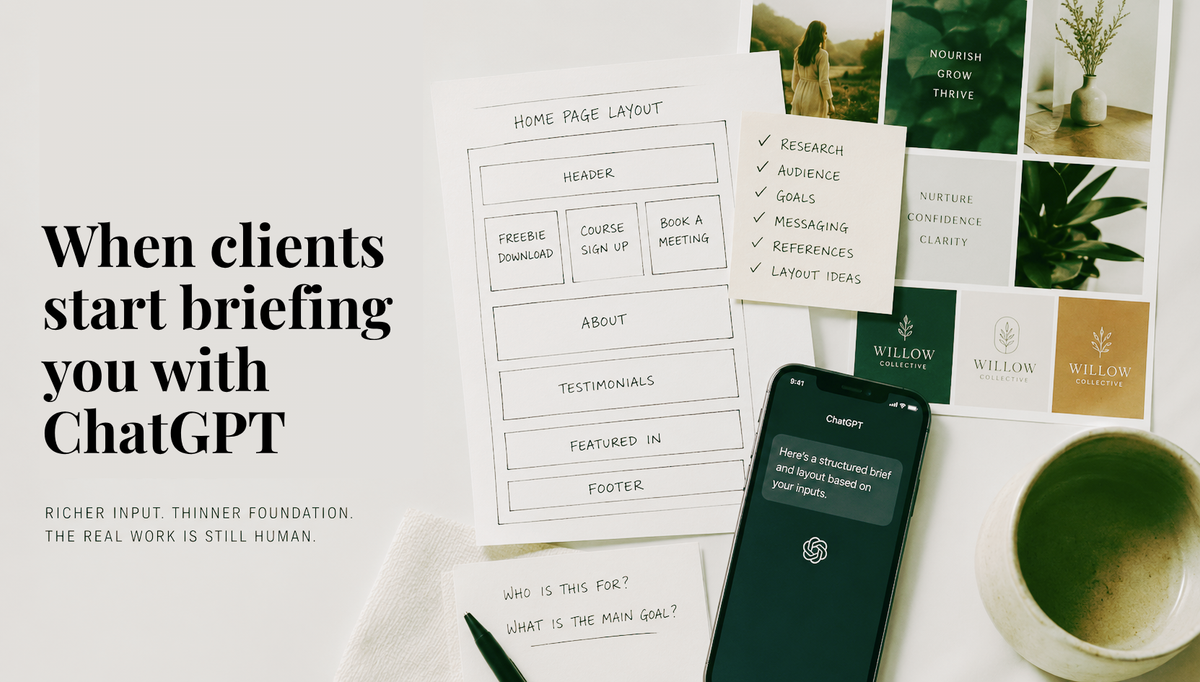
Attached were references. Several images of how she imagined her brand, what colors and visual direction felt right. And a rough layout for the home page with the content blocks she wanted to include.
On the surface, it was a lot of input. More than most clients send. But when I sat with it, two things started to bother me, and a third one took a few days to surface.
Three or four directions sitting next to each other
The first was that the references were inconsistent. The images had different color treatments, different logo variations, slightly different moods. To her, they probably felt like one direction. To a designer or PM, they read as three or four different directions sitting next to each other. Without brand guidelines or any system anchoring them, they say "I like all of these things at the same time", which is a different problem than "this is the direction". Photography ranged from warm outdoor shots to muted indoor ones. Logos showed up in slightly different colors across the same set of images. None of it was wrong on its own. None of it cohered.
The pre formed layout is the new mood board
The second observation took me longer to put into words.
She had taken the time to sketch out a home page with all the blocks she wanted on it. A header, a freebie download, a course signup, a meeting booking, testimonials, and a few more sections stacked in a specific order. As a designer, I'm not expecting to start from anything a client sends me. I always start from a blank slate. That's part of what they're paying for. So the issue isn't that her layout wasn't usable, it's that the moment a client sends a specific layout, something subtle happens. Their vision lands in my head. Now I have a half formed picture that wasn't mine, and I have to decide what to do with it.
Translate it directly? That would limit me to her thinking, which is exactly the kind of thinking she hired me to bypass. Ignore it completely? That feels dismissive of her effort, and also probably loses useful signal about what she actually cares about. So the real work becomes holding both at once. Take her vision seriously as input. Actively keep my own thinking unconstrained. Start from blank, but informed.
This is new. Or at least, much more present than it used to be. Clients have always come with opinions, but AI is making it easier for them to arrive at projects already half decided. The pre formed layout is the new mood board. And learning to handle that without letting it become a ceiling on the work is a small but real shift in how this job feels.
The questions were still unanswered
The third thing took longer to notice, and it might matter the most.
Even after she sent all of this, the core strategic questions were still unanswered. Who exactly is this website targeting? She has multiple audiences in mind and hasn't picked a primary one. What is the main goal of the home page? She mentioned a free PDF, signing up for a course, and booking a meeting. A home page can't optimize for all three equally. There has to be a hierarchy. One main thing the page is trying to do, and the rest sits below that.
So I sent her the questions back. Who is the main target audience. What is the one primary goal of the website. The kind of questions that should sit at the start of any project, and that no amount of mood references or AI drafted briefs can replace.
Richer input can hide a thinner foundation
This is the part of the AI and design conversation that I don't think is being talked about enough.
AI is genuinely helpful for clients trying to articulate what they want. It can pull references, draft messages, suggest layouts. It gives clients a vocabulary they didn't have before. Five years ago a client like this might have sent a Pinterest link and a paragraph. Now she sent a structured plan, mood references, and a layout sketch. The input is richer.
But richer input can hide a thinner foundation.
A long structured message reads like a brief, but a brief is more than a list of things you want on the website. References look like a direction, but direction needs consistency and a reason behind every choice. A layout with all the content blocks looks like a plan, but a plan needs a hierarchy and a goal. And once you're looking at a pre decided layout, you also have to actively manage how much it's allowed to influence you.
What hasn't changed
The work designers and PMs do hasn't really changed because of this. If anything, it's become more visible. We're still the ones asking the questions that move a project from "things I want" to "thing this needs to be". That layer doesn't show up in the AI output. It only shows up in the conversation we have with the client after.
I expect this to keep shifting. The references will get more polished, the briefs will get more structured, and at some point clients will start checking our work back through AI too. "ChatGPT said this should be different, what do you think?" I haven't hit that moment yet on a project, but it feels close. The way to handle it is probably the same as everything else. Take it seriously as input. Don't let it replace the conversation. Know what the project needs better than the AI does, and be able to explain why.
For now, I'm treating input that came through AI the way I treat any other input. Useful signal. Not the brief itself. Still ask the questions. Still build the foundation. Still come back to who this is for and what it's supposed to do. And when a client arrives with a finished looking vision, I'm learning to hold it lightly. Respect it as thinking. Don't let it become the ceiling.
The tools are getting better. The fundamentals haven't moved.